Have you ever been absolutely certain you remembered something correctly, only to discover that reality says otherwise? Maybe you could have sworn the Monopoly Man wore a monocle, remembered Darth Vader saying, “Luke, I am your father,” or believed the children’s book series was spelled The Berenstein Bears. If so, you’ve experienced what has become known as the Mandela Effect—a fascinating phenomenon that highlights just how unreliable human memory can be.
The Origin of the Name
The term Mandela Effect was coined in 2009 by paranormal researcher Fiona Broome after she realized she wasn’t alone in believing that South African leader Nelson Mandela had died in prison during the 1980s. In reality, Mandela was released in 1990, became South Africa’s first Black president in 1994, and died in 2013.
Broome discovered that many other people shared the same false memory, some even recalling television coverage of his funeral. The widespread nature of the mistake inspired the name for the broader phenomenon.
How Can So Many People Be Wrong?
The Mandela Effect is often explained through psychology rather than mystery. Human memory isn’t like a video recording that faithfully captures events. Instead, it’s a reconstructive process. Every time we remember something, our brains rebuild the memory from fragments, filling in missing details based on experience, expectations, and suggestions.
Several psychological factors contribute to the phenomenon:
False memories occur when people confidently remember events that never happened.
Confabulation happens when the brain unconsciously fills gaps in memory with information that feels plausible.
Social reinforcement strengthens incorrect memories as people discuss and validate each other’s recollections.
Schema theory suggests our brains rely on mental patterns that simplify information, sometimes leading us to “correct” memories into forms that seem more logical.
 Famous Examples

Perhaps the best-known Mandela Effect involves the children’s books The Berenstain Bears. Many adults vividly remember them as the Berenstein Bears, even though every published edition has always used “Berenstain.”
Another classic example is the Monopoly Man. Countless people remember him wearing a monocle, despite the fact that he never has. Researchers believe people may unconsciously blend him with other wealthy cartoon characters, such as Mr. Peanut.
Movie quotes are another rich source of false memories. Darth Vader’s famous line in The Empire Strikes Back is actually:
“No, I am your father.”
Yet millions remember hearing:
“Luke, I am your father.”
The altered version provides context when quoted outside the film, making it easier to remember and repeat.
Similarly, many people recall Snow White beginning with:
“Mirror, mirror on the wall…”
In Disney’s 1937 film, however, the Evil Queen actually says:
“Magic mirror on the wall…”
Brand Names and Logos
The Mandela Effect frequently appears in product branding.
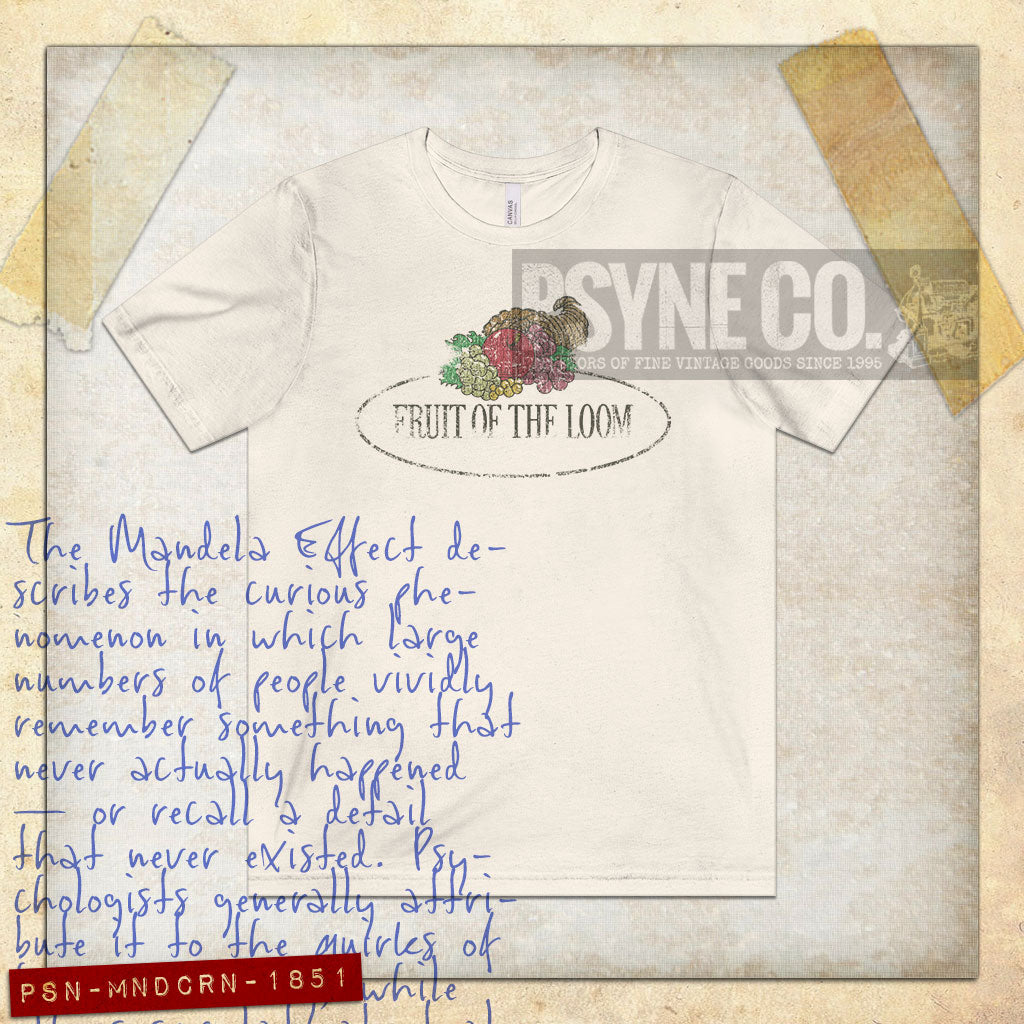
Many people insist that Fruit of the Loom once featured a cornucopia behind its fruit logo. No official version has ever included one.
Lots of people swear that Jif peanut butter was originally called Jiffy.
Others remember Kit-Kat with a hyphen or think the cereal is called Fruit Loops instead of Froot Loops. Brand familiarity often leads our brains to unconsciously “correct” unusual spellings into more conventional ones.
Paranormal Explanations
Not everyone accepts the psychological explanation. Some enthusiasts believe the Mandela Effect is evidence of alternate realities, parallel universes, or timeline shifts. According to these theories, people occasionally retain memories from previous versions of reality that have somehow merged with our own.
These ideas are popular in science fiction and online discussions, but there is currently no scientific evidence supporting them. They remain speculative interpretations rather than established explanations.
What Science Says
Modern neuroscience suggests that the Mandela Effect reveals more about how memory works than about the nature of reality.
Studies consistently show that memory is surprisingly flexible. Witnesses to the same event often recall different details, and subtle suggestions can alter memories without people realizing it. Confidence is also a poor indicator of accuracy; someone can vividly remember something that never occurred.
Rather than being a flaw unique to certain individuals, these memory distortions are a normal part of human cognition. Our brains prioritize meaning and efficiency over perfect accuracy.
Why It Fascinates Us
The Mandela Effect captures people’s imagination because it challenges one of our strongest assumptions—that our memories can be trusted. Discovering that thousands or even millions of others share the same incorrect recollection makes the experience even more compelling.
Whether viewed as a quirk of psychology or a gateway to imaginative theories about parallel worlds, the Mandela Effect reminds us that human memory is both powerful and imperfect. It demonstrates that our recollections are not fixed recordings of the past but dynamic reconstructions shaped by perception, expectation, and experience. Far from diminishing the wonder of the human mind, the Mandela Effect offers a fascinating glimpse into how our brains make sense of the world—and how easily certainty can give way to surprise.