Few horror franchises have evolved as dramatically—or as entertainingly—as Sam Raimi’s original Evil Dead trilogy. Beginning as a brutally low-budget independent horror movie and ending as a medieval fantasy loaded with slapstick comedy, the three films transformed Bruce Campbell’s Ash Williams from an ordinary college kid into one of horror cinema’s most recognizable heroes. Along the way, Raimi and company created a uniquely manic combination of gore, demonic possession, Three Stooges-style physical comedy, and wildly inventive filmmaking.
 The story began with The Evil Dead in 1981, an independent production made by a group of young Michigan filmmakers working with little money and plenty of ambition. Raimi directed, Campbell starred and co-produced, and producer Robert Tapert helped hold the chaotic production together. The premise was wonderfully simple: five young people travel to an isolated cabin in the Tennessee woods, where they discover a mysterious book and a recording of ancient incantations. Playing the tape awakens demonic forces that begin possessing the group one by one.
What followed was an assault of blood, screaming, dismemberment, and increasingly outrageous supernatural violence. Raimi compensated for the film’s limited resources with relentless creativity, particularly his racing point-of-view shots representing an unseen evil tearing through the forest. The Evil Dead was rough around the edges, but that rawness became part of its appeal. Stephen King famously championed the movie, helping it gain attention and distribution, while its extreme violence earned it notoriety during Britain’s “video nasty” controversy.
 Raimi returned to the material with Evil Dead II in 1987, but rather than simply repeating the first movie, he reinvented it. The opening portion essentially provides a streamlined reworking of the original setup before launching Ash into another night of demonic insanity. This time, however, Raimi pushed the comedy much further. Ash battles his own possessed hand, smashes plates over his head, gets drenched in blood, and is subjected to increasingly elaborate physical punishment. Campbell proved remarkably suited to the approach, combining the exaggerated reactions of a silent-film comedian with the swagger of a B-movie action hero.
Evil Dead II also established the version of Ash that would define the franchise. After losing his hand, he replaces it with a chainsaw and arms himself with a sawed-off shotgun. The frightened survivor of the original gradually becomes a wisecracking monster killer, complete with torn shirt, blood-covered face, and increasingly ridiculous confidence. By the finale, Ash is sucked through a portal and deposited in medieval times, providing the setup for the trilogy’s strangest chapter.
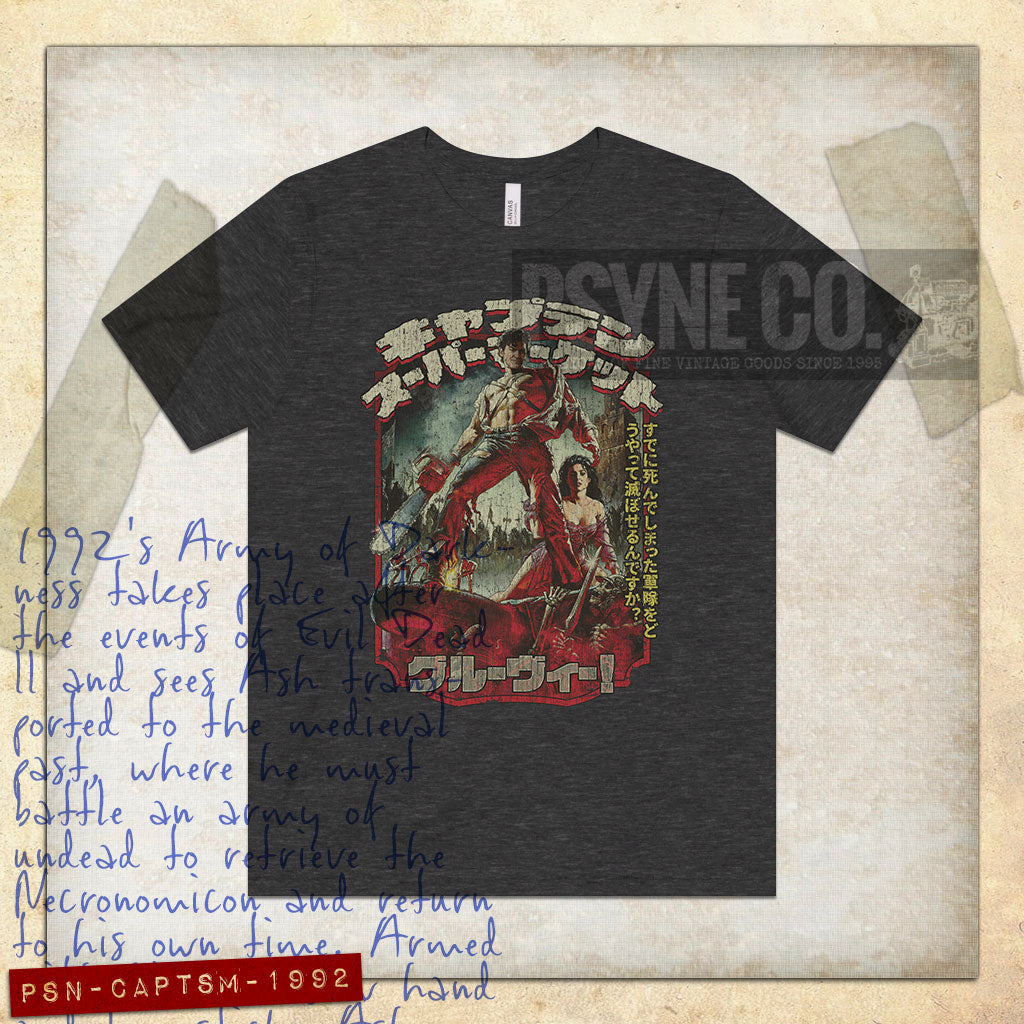
 Released in 1992, Army of Darkness abandoned the cabin almost entirely and sent Ash into a sword-and-sorcery adventure. Stranded in the Middle Ages, he must recover the Necronomicon and battle an army of undead creatures before he can return home. Horror remained part of the formula, but Raimi embraced fantasy, adventure, stop-motion effects, and broad comedy. Campbell’s Ash was now a full-fledged caricature of the macho action hero: arrogant, frequently incompetent, and somehow capable of saving the day anyway.
The change in tone made Army of Darkness considerably different from the movie that started everything. Skeleton armies, castles, witches, miniature Ashes, and the villainous “Evil Ash” replaced much of the claustrophobic terror of the first film. It was less frightening, but its endlessly quotable dialogue and comic-book energy helped turn it into a cult favorite.
Taken together, the original trilogy is almost a record of Raimi and Campbell discovering what Evil Dead could be. The Evil Dead is grimy independent horror, Evil Dead II is a splatter-comedy nightmare, and Army of Darkness is a supernatural fantasy adventure. Rather than maintaining a perfectly consistent tone or continuity, each movie exaggerates a different part of the concept.
That willingness to mutate is a major reason the trilogy has endured. Behind all the gallons of fake blood and chainsaw mayhem was the unmistakable enthusiasm of filmmakers willing to try practically anything to get a memorable shot. What started with a handful of friends, a tiny budget, and a cabin in the woods ultimately produced one of cult cinema’s great characters—and three movies that proved horror could be frightening, disgusting, hilarious, and completely ridiculous all at once.