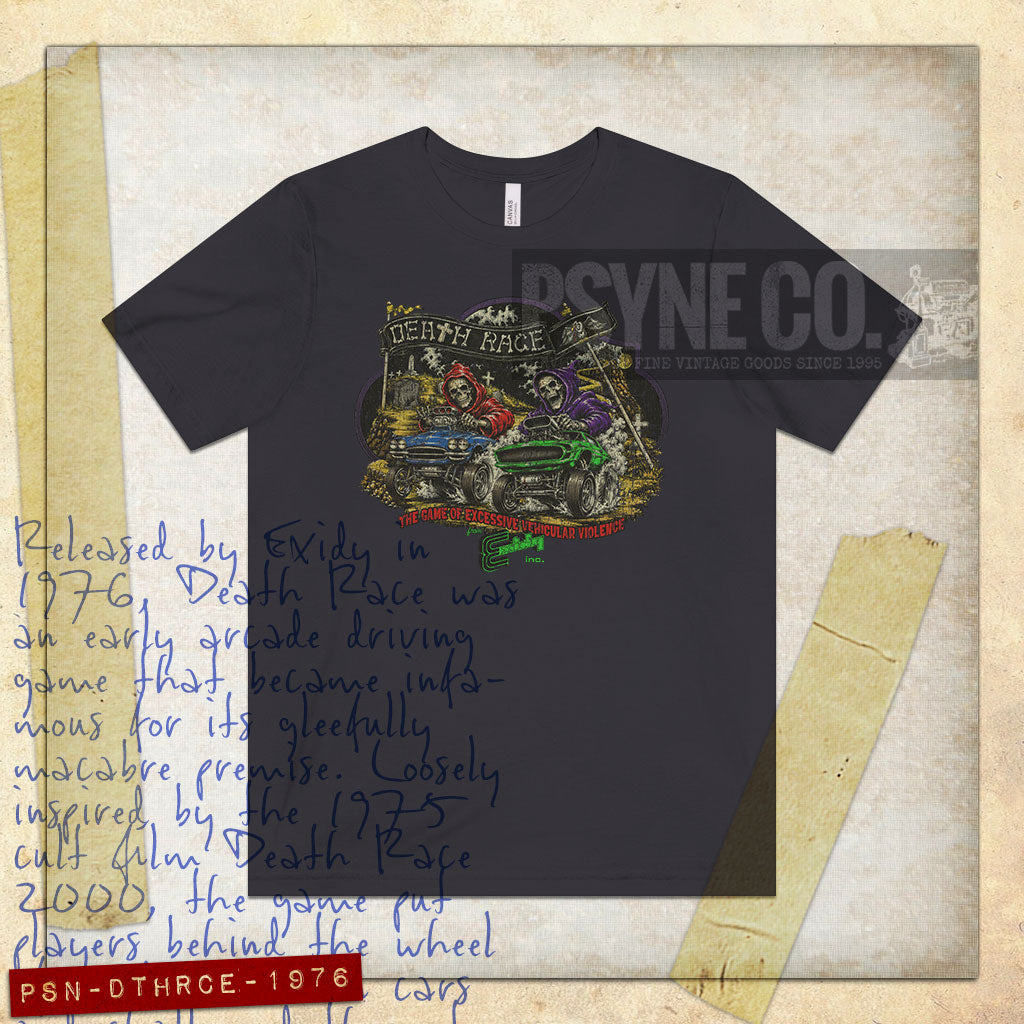
Long before Mortal Kombat, Doom, or Grand Theft Auto became lightning rods in debates over video game violence, there was Death Race. Released by the California arcade manufacturer Exidy in 1976, the stark black-and-white driving game was extraordinarily primitive by modern standards. Yet its simple premise—steering a car around the screen and deliberately running down fleeing figures—was enough to ignite what is widely regarded as the first major national controversy over violence in a video game.
Death Race grew out of Exidy’s earlier 1975 game Destruction Derby. After licensing that game to Chicago Coin, Exidy needed a substantially different product it could sell itself. Engineer Howell Ivy modified the existing hardware, replacing the other cars with animated stick-like figures that wandered around the screen. The result initially appeared under the name Death Race 98 before becoming simply Death Race.
Gameplay couldn’t have been much simpler. One or two players controlled cars using steering wheels and pedals and chased small figures around a top-down playing field. Exidy officially called the targets “gremlins,” fitting the game’s horror-themed artwork. Hitting one earned points, produced a shrieking sound effect, and caused a cross-shaped tombstone to appear where the unfortunate creature had been standing. Those tombstones remained on the playing field, gradually turning the screen into an increasingly cluttered graveyard.
 The trouble was that the so-called gremlins looked an awful lot like people.
In an era when arcade graphics consisted of little more than glowing lines and crude blocks, there wasn’t much visual distinction between a monster and a pedestrian. The combination of humanoid targets, screams, tombstones, and a title like Death Race made Exidy’s insistence that players were merely chasing fantasy creatures a difficult sell. The game’s cabinet and promotional material leaned heavily into its morbid theme as well, with player rankings including names such as “Skeleton Chaser,” “Bone Cracker,” and “Gremlin Hunter.”
The controversy exploded during the summer of 1976. Associated Press reporter Wendy Walker encountered the machine at a Seattle-area arcade and subsequently wrote about it, describing what appeared to be cars running down human figures and drawing particular attention to the disturbing sound produced when one was hit. Her July story was syndicated in more than a hundred newspapers around the country, exposing millions of Americans to Death Race who otherwise probably never would have heard of it.

Soon Death Race had become a national talking point. Newspapers, civic organizations, and television programs questioned whether a game that rewarded players for apparently mowing down pedestrians was appropriate entertainment, particularly for children. The National Safety Council criticized the game, and the controversy eventually reached national television. What had begun as a relatively obscure coin-operated amusement was suddenly being discussed as evidence of the potentially troubling psychological effects of a new form of electronic entertainment.
Exidy pushed back. Company representatives emphasized that the creatures were gremlins rather than human beings and defended the game as fantasy. From their perspective, Death Race wasn’t substantially different from the countless games and amusements built around monsters, shooting, destruction, and make-believe violence. Critics saw something different: a machine that explicitly awarded points for steering a vehicle into figures that looked human and then marked their deaths with gravestones.

There is also a persistent connection between the game and Roger Corman’s 1975 cult movie Death Race 2000, in which competitors score points for killing pedestrians during a cross-country automobile race. Contemporary audiences naturally made the connection, and some later accounts have described the arcade game as an adaptation. The actual relationship is murkier. Exidy personnel maintained that the game was not a licensed adaptation and that its concept developed from modifying Destruction Derby. Academic research has nevertheless argued that the Death Race name inevitably encouraged audiences to associate the machine with the notorious film.
Ironically, the outrage may have been the best advertising Exidy could have purchased. The company had not expected Death Race to become a major phenomenon; it was essentially an interim product. But national coverage transformed an obscure arcade cabinet into something people actively wanted to see for themselves. Exidy employees later credited the negative publicity with substantially increasing interest and sales.
That is ultimately what makes Death Race historically important. Its graphics are crude, its gameplay is basic, and the supposedly horrifying violence amounts to little more than tiny white figures disappearing from a monochrome screen. But the arguments surrounding it sound remarkably familiar nearly half a century later: Does simulated violence encourage real violence? Are children especially vulnerable to violent entertainment? Does context matter more than graphical realism? And are media controversies sometimes responsible for making supposedly dangerous entertainment even more desirable?
Death Race didn’t settle any of those questions. It did, however, establish a pattern that the video game industry would encounter repeatedly over the following decades. When controversies erupted around Mortal Kombat, Night Trap, Doom, and later Grand Theft Auto, the technology had changed beyond recognition, but much of the debate had not. In 1976, Death Race gave America its first real taste of the video game violence controversy—and demonstrated that sometimes the surest way to make people want to play a game is to tell them they shouldn’t.