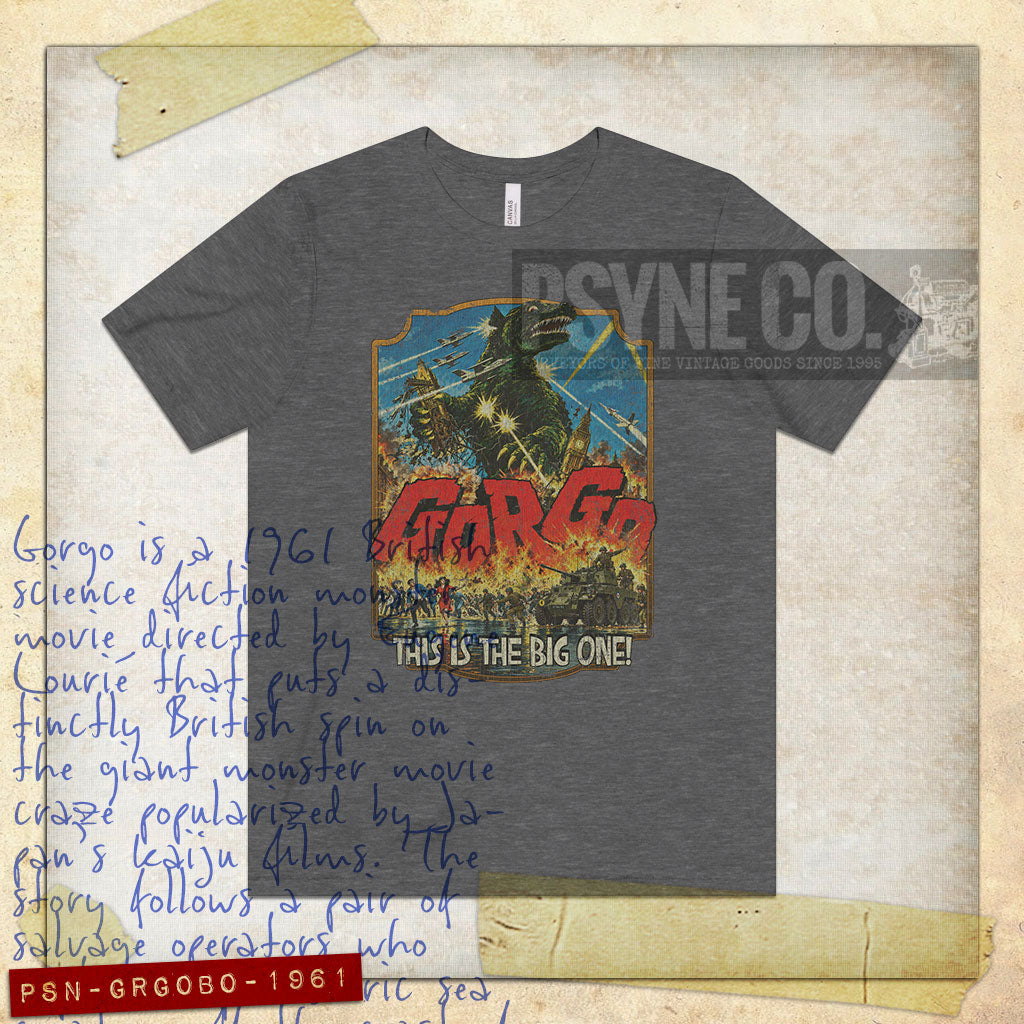
Released in 1961, Gorgo is a British science fiction monster movie that brought the giant creature craze of the 1950s to the streets of London. Directed by Eugène Lourié and starring Bill Travers, William Sylvester, and Vincent Winter, the film borrowed heavily from the Japanese kaiju movies that had become international sensations following the release of Godzilla in 1954. However, while most giant monster movies ended with humanity triumphing over some prehistoric menace, Gorgo offered a surprisingly sympathetic twist that made its towering creatures considerably more likable than the people trying to destroy them.
The story begins off the coast of Ireland, where an underwater volcanic eruption unleashes a prehistoric sea creature that has remained hidden beneath the ocean for millions of years. Two opportunistic salvage operators, Joe Ryan (Bill Travers) and Sam Slade (William Sylvester), manage to capture the enormous reptilian beast despite warnings from local residents and scientists.
 Recognizing a golden opportunity to make some money, the pair transport their discovery to London, where an unscrupulous circus promoter puts the creature on public display. Dubbed Gorgo, the monster quickly becomes a sensational attraction, drawing enormous crowds eager to see the supposedly terrifying beast. Unfortunately, the spectacle takes a disastrous turn when scientists discover that the captured creature is merely an infant, and its considerably larger mother is heading straight for London to retrieve her offspring.
 What follows is a spectacular rampage through the British capital as the gigantic mother monster emerges from the Thames and begins demolishing everything standing between her and her captive baby. Tower Bridge, Big Ben, Westminster Abbey, and other familiar London landmarks are reduced to rubble as military forces unleash everything in their arsenal against the seemingly unstoppable creature. Tanks, artillery, naval vessels, and fighter aircraft prove virtually useless, leaving the authorities helpless as much of the city descends into chaos. Unlike the rampaging monsters of many contemporary science fiction films, however, Gorgo’s mother isn’t interested in conquering the world or destroying humanity. She simply wants her baby back, and anyone unfortunate enough to get in her way is going to have a very bad day.
Gorgo was produced by the American King Brothers production company, with filming taking place at MGM’s British studios in Borehamwood, Hertfordshire, as well as locations around London and Ireland. Interestingly, the filmmakers originally considered setting the story in Japan before entertaining the possibility of having the creature terrorize Paris. Ultimately, London was selected, giving British audiences the unusual opportunity to watch their own famous landmarks flattened by an oversized monster. The production also benefited from the involvement of Lourié, who was already something of a veteran of prehistoric creature features, having directed The Beast from 20,000 Fathoms (1953) and The Giant Behemoth (1959).
 Rather than relying on stop-motion animation, Gorgo employed the Japanese technique of placing actors inside elaborate rubber monster costumes, allowing the creatures to interact directly with miniature buildings and environments. Special effects supervisor Tom Howard combined these performances with detailed miniature sets, optical effects, and high-speed photography to create the illusion of enormous creatures moving through the city. While some of the effects may appear charmingly primitive by modern standards, the destruction sequences remain impressive examples of practical filmmaking, particularly the scenes involving Tower Bridge and the Houses of Parliament. The film’s vivid color photography also helped distinguish it from the black-and-white creature features of the preceding decade.

Perhaps the film’s most memorable quality is its unexpectedly compassionate ending. Rather than allowing humanity to triumph through superior firepower, Gorgo concludes with the mother successfully rescuing her baby and returning to the ocean, leaving a devastated London behind. It’s a refreshing departure from the usual monster movie formula, particularly because the humans are largely responsible for bringing the catastrophe upon themselves. Their greed, arrogance, and determination to exploit a living creature for profit ultimately result in widespread destruction, while the supposedly monstrous animals emerge as the story’s most sympathetic characters.
Although Gorgo received mixed reviews upon its original release, it gradually developed a devoted following among fans of classic science fiction and giant monster movies. Its combination of British locations, Japanese-inspired monster effects, spectacular destruction, and surprisingly heartfelt storytelling helped establish it as a cult favorite. More than six decades later, Gorgo remains a wonderfully entertaining example of old-fashioned monster movie mayhem, proving that sometimes the biggest, scariest creature in the world is just a mother looking out for her kid. And if rescuing that kid means knocking down half of London, well, that’s simply the price of doing business.
Gorgo was featured in a highly memorable and historically rare episode of Mystery Science Theater 3000 – “Gorgo” (Season 9, Episode 9). Originally airing on Sci-Fi Channel on July 18, 1998, the episode featured Mike Nelson and the Bots riffing on the 1961 British giant monster movie, which naturally made for great MST3K fodder.