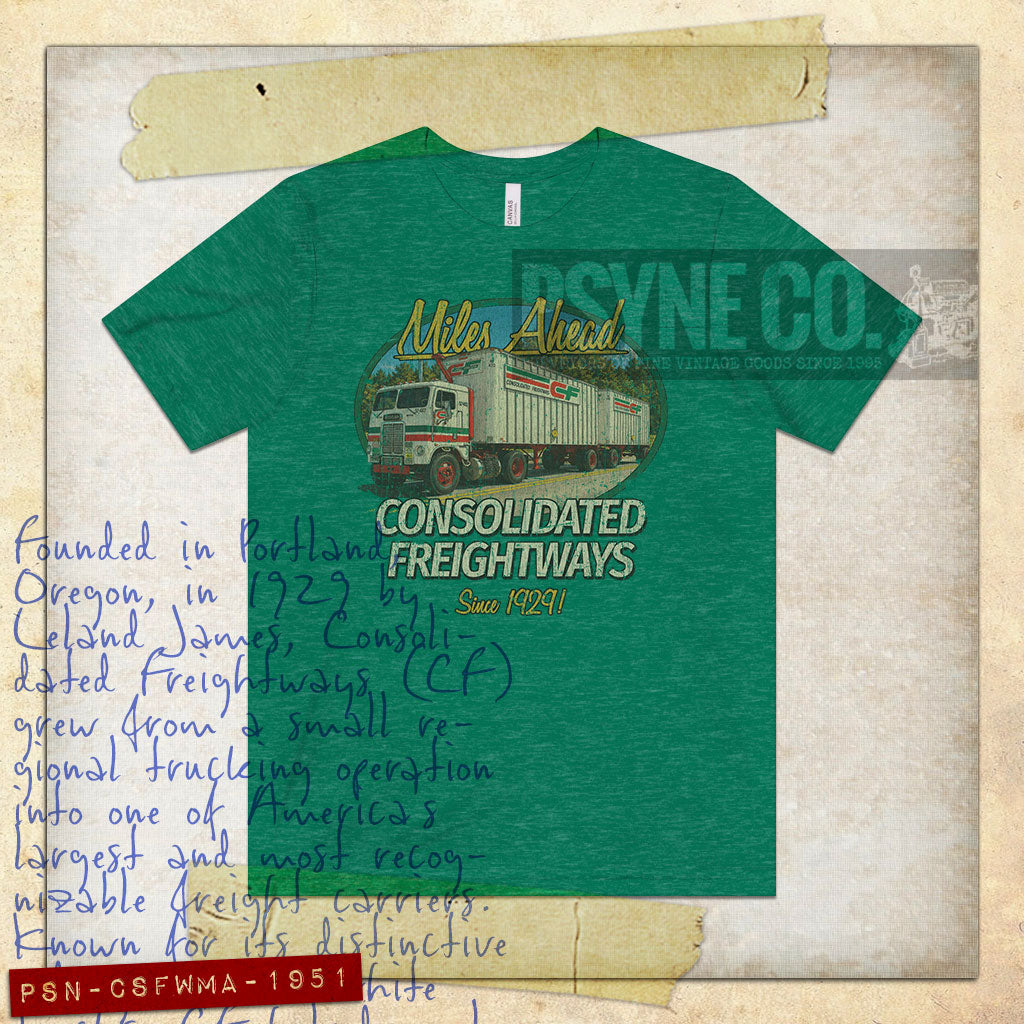
Few trucking companies left a mark on American transportation quite like Consolidated Freightways. With its distinctive red, green, and white trucks, innovative equipment, and sprawling network of freight terminals, Consolidated Freightways (CF) became one of the largest and most recognizable names in the industry. For more than seven decades, the company helped move America’s economy forward, pioneering new approaches to trucking and establishing a legacy that would extend well beyond its eventual demise.

Humble Beginnings in the Pacific Northwest
Consolidated Freightways was founded in Portland, Oregon, in 1929 by trucking entrepreneur Leland James, who combined four smaller regional carriers into a single operation. Originally known as Consolidated Truck Lines, the company began serving communities throughout the Pacific Northwest at a time when trucking was still struggling to establish itself as a serious competitor to the nation’s railroads.
Despite launching just as the Great Depression began, Consolidated managed to survive the difficult economic conditions of the 1930s. James recognized that trucking offered something railroads couldn’t always provide: the flexibility to transport smaller shipments directly between businesses and communities without relying on railroad infrastructure.
Through strategic acquisitions and an expanding network of routes, Consolidated steadily increased its presence throughout Oregon, Washington, and California. World War II brought additional opportunities as the nation’s transportation infrastructure struggled to keep pace with wartime demands. By the end of the war, CF had established dozens of freight terminals and extended its operations as far east as Chicago.

Building Better Trucks
One of Consolidated Freightways’ most significant contributions to American trucking came not from hauling freight, but from building the trucks themselves.
During the late 1930s, Leland James became frustrated with the limitations of commercially available heavy trucks. He wanted lighter, more efficient vehicles capable of hauling greater payloads while navigating the challenging mountain highways of the American West.
When established truck manufacturers showed little interest in his ideas, James assembled his own engineering team and began developing trucks using lightweight aluminum components and cab-over-engine configurations.
The effort eventually resulted in the establishment of Freightliner Corporation in 1942. Initially developed to meet Consolidated’s equipment requirements, Freightliner began manufacturing trucks for outside customers after World War II. A distribution agreement with White Motor Corporation in 1951 helped introduce Freightliner trucks to customers nationwide.
The resulting White-Freightliner cab-over tractors became some of the most recognizable commercial vehicles on American highways, establishing a design tradition that would define heavy-duty trucking for decades.
 Miles Ahead: The Golden Age of CF
The 1950s and 1960s represented a remarkable period of expansion for Consolidated Freightways. America’s growing interstate highway system, booming manufacturing economy, and increasing demand for dependable freight transportation created ideal conditions for the company’s continued growth.
By 1959, Consolidated had become the nation’s largest common freight carrier, generating approximately $146 million in annual revenue and operating thousands of trucks and trailers across 34 states and Canada.
The company’s growing fleet featured its unmistakable CF insignia and distinctive red, green, and white paint scheme. Among truck drivers, the company acquired the affectionate nickname “Corn Flakes,” a playful reference to its initials.
Innovation remained central to Consolidated’s identity. The company championed lightweight equipment, diesel-powered tractors, and the use of double-trailer combinations to improve operating efficiency and increase freight capacity. These developments helped establish operating practices that would eventually become commonplace throughout the trucking industry.
Consolidated’s forward-looking approach was reflected in the phrase “Miles Ahead,” which appeared in company-related promotional material. The broader CF organization later used the advertising slogan “We Put You Miles Ahead,” capturing a philosophy that had helped build the company into an industry leader.

Expansion, Deregulation, and Changing Times
Throughout the 1970s, Consolidated remained a dominant force in the American freight industry. However, rising fuel costs, increasing competition, and changing economic conditions presented new challenges.
The Motor Carrier Act of 1980 dramatically altered the trucking business by deregulating much of the industry. Established carriers that had operated for decades under federally regulated routes and rates suddenly faced competition from newer, often smaller companies with lower operating costs.
Consolidated responded by restructuring its operations and selling Freightliner Corporation to Daimler-Benz in 1981. The sale allowed CF to concentrate on its core freight transportation business, while Freightliner continued developing into one of America’s leading heavy-truck manufacturers.
During the 1980s, the company also established the Con-way regional trucking network, specializing in shorter routes and expedited freight service. The new operation grew rapidly, eventually becoming a significant business in its own right.
Despite these efforts, the increasingly competitive trucking market placed considerable pressure on Consolidated’s traditional long-haul operations. Price wars, rising expenses, and declining profit margins made it difficult for the company to maintain its once-commanding position.
In 1996, Consolidated’s parent organization separated its traditional long-haul business from its other transportation operations. The long-haul carrier retained the Consolidated Freightways name, while Con-way and several other businesses remained with the newly renamed CNF Transportation.
 The End of the Road
By the beginning of the 21st century, Consolidated Freightways was struggling financially. Years of intense competition, mounting expenses, and unsuccessful restructuring efforts had weakened the company considerably.
The economic downturn of 2001 made matters worse, and CF found itself increasingly unable to generate sufficient revenue to cover its operating expenses.
On September 2, 2002, Consolidated Freightways announced that it would immediately cease its U.S. operations. The following day, the company filed for Chapter 11 bankruptcy protection, bringing an abrupt end to 73 years of trucking history.
Approximately 15,500 employees lost their jobs, while hundreds of freight terminals closed and thousands of trucks and trailers were taken out of service. The sudden shutdown shocked the transportation industry, particularly the generations of drivers, mechanics, dockworkers, and dispatchers who had spent their careers with the company.
At the time of its collapse, Consolidated Freightways remained one of America’s largest trucking companies, with an extensive terminal network and annual revenues exceeding $2 billion.

A Legacy That Lives On
Although Consolidated Freightways disappeared from American highways in 2002, its influence on the trucking industry remains undeniable.
The Freightliner brand that Leland James helped create continues to be a major force in commercial truck manufacturing. Likewise, Con-way, another business developed under the Consolidated umbrella, continued operating for years before its acquisition by XPO Logistics in 2015.
Beyond those corporate descendants, CF’s lasting contributions include advances in truck design, freight handling, fleet efficiency, and the development of nationwide transportation networks.
For trucking enthusiasts and former employees, the sight of an old Consolidated Freightways tractor or trailer still evokes memories of an era when the company’s red, green, and white equipment seemed to be everywhere.
From its beginnings as a small Portland trucking company to its position as one of America’s largest freight carriers, Consolidated Freightways helped define the golden age of American trucking. And while the company’s trucks may have made their final runs decades ago, the CF name remains firmly embedded in the history of the open road.