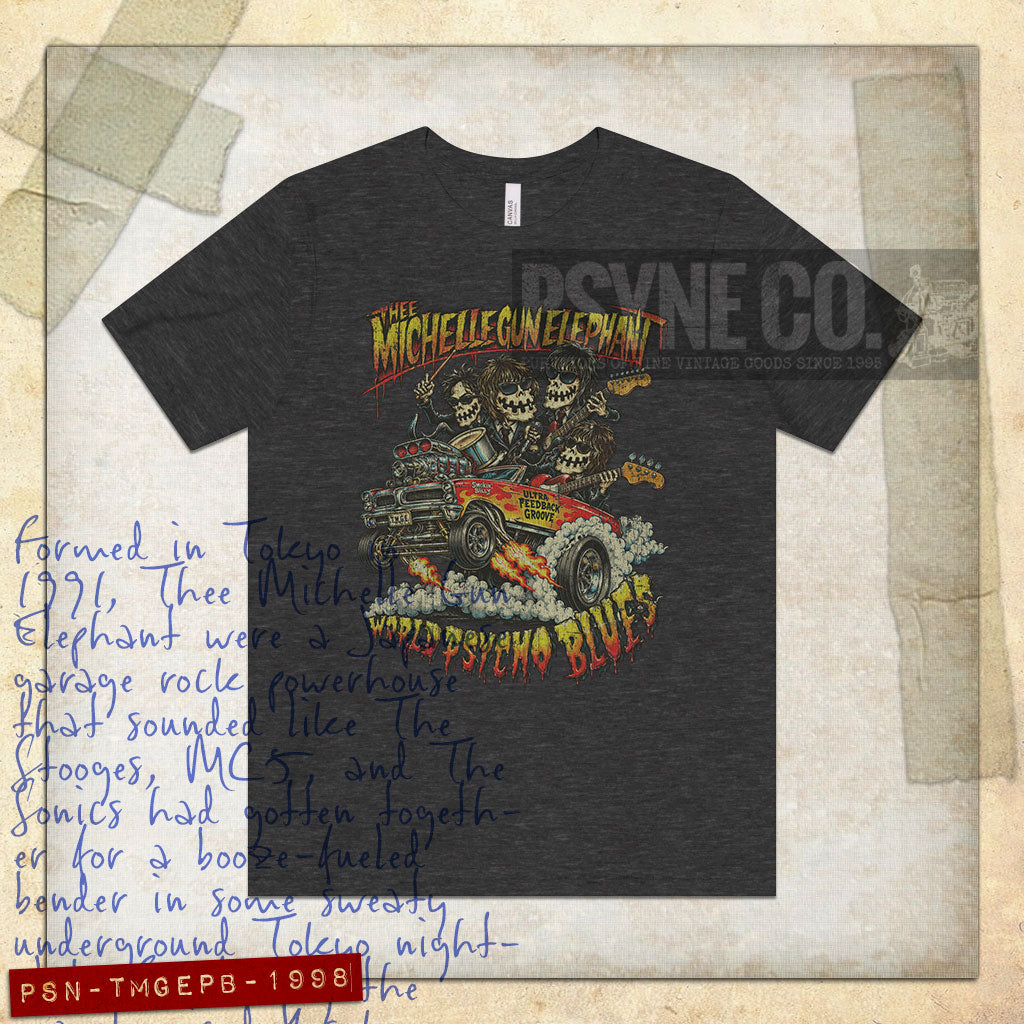
TL;DR: How four guys in black suits turned vintage rock ’n’ roll into a full-blown sonic assault.
While much of the world spent the 1990s obsessing over grunge, Britpop, and alternative rock, four guys from Tokyo were busy resurrecting the raw, filthy spirit of garage rock and turning it into something downright explosive. Armed with vintage guitars, cheap suits, cigarettes, and an almost religious devotion to rock ’n’ roll, Thee Michelle Gun Elephant became one of Japan’s most influential and uncompromising rock bands. Their sound was loud, fast, and gloriously primitive, combining the swagger of The Rolling Stones, the aggression of MC5, the chaos of The Stooges, and the stripped-down intensity of British punk.
They weren’t particularly interested in reinventing rock ’n’ roll. They just wanted to play it louder, faster, and harder than just about anybody else.
 From Tokyo’s Underground to Rock ’n’ Roll Stardom
Thee Michelle Gun Elephant formed in Tokyo in 1991, initially emerging from the city’s underground music scene while several members were attending Meiji Gakuin University. The band’s classic lineup consisted of vocalist Yusuke Chiba, guitarist Futoshi Abe, bassist Koji Ueno, and drummer Kazuyuki Kuhara. Abe joined in June 1994, completing the four-piece lineup that would become legendary among Japanese rock fans.
Even the band’s peculiar name had suitably bizarre origins. According to band lore, it came from a mispronunciation of Machine Gun Etiquette, the title of The Damned’s 1979 album. Somewhere along the way, those words became Thee Michelle Gun Elephant, a name that made absolutely no sense but somehow perfectly suited the music.
Early influences included British pub rock, punk, blues, and American garage bands like The Sonics, The Stooges, and MC5. Japanese rockers The Roosters were another major inspiration. But rather than simply copying their heroes, the band developed a distinctive sound that was immediately recognizable.
Chiba’s raspy, cigarette-scorched vocals sounded like a man who had spent the previous three nights drinking whiskey and screaming into a telephone. Abe’s razor-sharp guitar playing was relentless, delivering machine-gun riffs and frantic rhythms with almost mechanical precision. Meanwhile, Ueno and Kuhara provided a thunderous rhythm section that kept everything moving at breakneck speed.
Together, they sounded like a runaway freight train barreling through a garage full of vintage amplifiers. AllMusic
 Dressed to Kill, Playing to Destroy
There was something refreshingly straightforward about Thee Michelle Gun Elephant’s image. While other bands embraced elaborate costumes, theatrical stage productions, or the increasingly fashionable grunge aesthetic, these guys preferred tailored black suits, skinny ties, leather jackets, and dark sunglasses.
They looked like a gang of sharply dressed delinquents who had wandered out of a 1960s gangster movie and stumbled onto a punk rock stage.
Their performances were similarly stripped down. There were no elaborate light shows, no choreographed routines, and very little unnecessary banter. The band simply walked onstage and unleashed an almost continuous barrage of blistering rock ’n’ roll.
Chiba prowled the stage with an effortlessly cool presence, occasionally barking into the microphone between songs. Abe stood almost motionless at times, concentrating on delivering some of the most ferocious rhythm guitar playing imaginable.
The contrast between their controlled appearance and absolutely unhinged sound became part of the band’s appeal.
And Japanese audiences couldn’t get enough.
 The Rise of a Garage Rock Phenomenon
After building a devoted following in Tokyo’s live music clubs, Thee Michelle Gun Elephant released their independent EP Wonder Style in 1995.
The following year, they signed with Nippon Columbia’s Triad label and released their debut single, “Sekai no Owari” (“World’s End”), followed by their first full-length album, Cult Grass Stars, in March 1996.
Recorded in London, the album introduced the band’s distinctive combination of garage rock, punk, blues, and old-fashioned rock ’n’ roll to a much larger audience.
They wasted little time following it up.
Their second album, High Time, arrived in November 1996, while 1997’s Chicken Zombies pushed their sound further into noisy, hard-driving garage punk territory.
By this point, Thee Michelle Gun Elephant had become a major attraction in Japan, selling out shows and developing a reputation as one of the country’s most exciting live acts.
Their relentless touring schedule helped transform them from an underground curiosity into genuine rock stars, all without substantially compromising their stripped-down approach to music.
 Gear Blues and the World Psycho Blues Tour
If there was one album that perfectly captured Thee Michelle Gun Elephant at the height of their powers, it was 1998’s Gear Blues.
Released in November 1998, the band’s fourth studio album was a blistering collection of distorted guitar riffs, pounding drums, and snarling vocals that sounded like a vintage garage rock record pushed far beyond its breaking point.
Songs like “G.W.D,” “Out Blues,” and “Smokin’ Billy” became defining examples of the band’s sound, combining relentless rhythms with Chiba’s unmistakable vocal delivery.
The album also helped introduce the group to international audiences, eventually receiving an American release in 2000 through Alive Records.
But the real action was happening back home.
In December 1998, the band launched its appropriately titled World Psycho Blues Tour – All Standing! Maximum!!, an ambitious series of arena performances that continued into January 1999.
The tour represented a remarkable achievement for a band whose music seemed better suited to sweaty basement clubs than enormous concert halls.
Yet Thee Michelle Gun Elephant proved that their stripped-down garage rock could fill arenas without sacrificing its intensity.
The tour culminated in a massive January 17, 1999, performance at Yokohama Arena, where thousands of fans packed the venue for a high-volume celebration of everything the band represented.
That performance was immortalized in the concert video World Psycho Blues, released in May 1999.
The momentum continued with the World Gear Blues Tour, which began in April 1999 and included 62 performances across 40 locations in Japan.
For a band playing music rooted in obscure 1960s garage rock and British pub rock, their commercial success was nothing short of extraordinary. Thee Michelle Gun Elephant
Taking Japanese Monster R&B Around the World
Although Thee Michelle Gun Elephant were enormously popular in Japan, their influence gradually spread beyond their home country.
They toured internationally, performing in Europe and introducing overseas audiences to their particular brand of musical mayhem.
Their music was sometimes described as “Japanese Monster R&B,” a wonderfully appropriate label for a sound that combined primitive rhythm and blues with punk aggression and garage rock distortion.
While the British and American garage rock revival would become fashionable again in the early 2000s, Thee Michelle Gun Elephant had already been perfecting their version of the sound for nearly a decade.
Their international recognition never quite matched the massive following they enjoyed in Japan, but among garage rock enthusiasts, their recordings became highly regarded examples of uncompromising rock ’n’ roll.
And unlike many of their contemporaries, the band didn’t seem particularly interested in chasing mainstream trends or reinventing themselves to appeal to new audiences.
They had their sound, and they stuck to it.
 The Final Years and Last Heaven
Thee Michelle Gun Elephant continued their relentless recording schedule into the new millennium.
In 2000, they released Casanova Snake, another explosive collection of garage rock and punk-infused rhythm and blues.
The following year brought Rodeo Tandem Beat Specter, while 2003 saw the release of their final two studio albums, Sabrina Heaven and Sabrina No Heaven.
By then, the band’s sound had expanded somewhat beyond the frantic garage rock of their earlier recordings, incorporating darker atmospheres and more experimental arrangements.
But after more than a decade together, the end was approaching.
On September 1, 2003, Thee Michelle Gun Elephant publicly announced their impending breakup.
They embarked on a farewell tour appropriately titled Last Heaven, playing 13 shows across Japan before bringing their career to a close on October 11, 2003, at Makuhari Messe in Chiba.
Approximately 37,000 fans attended the final performance, an extraordinary farewell for a group that had started out playing tiny underground clubs.
The concert was documented in the film Burning Motors Go Last Heaven, preserving one final blast of the band’s legendary live energy.
After 12 years, eight studio albums, and countless performances, Thee Michelle Gun Elephant were finished.
And unlike so many other bands that eventually reunite for one more tour or payday, they never got back together. Thee Michelle Gun Elephant
A Legacy Written in Distortion
Sadly, any possibility of a reunion disappeared with the death of guitarist Futoshi Abe on July 22, 2009, at just 42 years old.
Abe’s distinctive guitar playing had been central to the band’s sound, and his death was a tremendous loss to Japan’s rock community.
Fourteen years later, vocalist Yusuke Chiba died on November 26, 2023, at age 55, following a battle with esophageal cancer.
Chiba had continued making music after Thee Michelle Gun Elephant, most notably with Rosso and The Birthday, maintaining his reputation as one of Japan’s most recognizable rock vocalists. タワーレコード オンライン
The band’s legacy, however, remains remarkably strong.
In 2025, a major 30th-anniversary project titled THEE 30TH celebrated their recording career with remastered albums, vinyl reissues, archival concert releases, and other material documenting their extraordinary run. The project continued into 2026, introducing their music to another generation of listeners. Thee Michelle Gun Elephant
What made Thee Michelle Gun Elephant special wasn’t that they invented a new musical genre or revolutionized the recording industry. They took the basic ingredients of rock ’n’ roll—electric guitars, bass, drums, and a singer with a bad attitude—and pushed them to their absolute limits.
They were living proof that rock music didn’t need complicated arrangements, expensive production, or some grand artistic statement to be powerful.
Sometimes all you needed was a great riff, a beat you could feel in your chest, and four guys who looked like they might burn the whole damn place down before the encore.
Thee Michelle Gun Elephant didn’t just play rock ’n’ roll. They made it sound dangerous again.