

“One of the most difficult problems for a journalist covering a presidential campaign is getting to know the candidates well enough to make confident judgments about them, because it is just about impossible for a journalist to establish a personal relationship with any candidate who has already made the big leap from ‘long shot’ to ‘serious contender.’ The problem becomes more and more serious as the stakes get higher, and by the time a candidate has survived enough primaries to convince himself and his staff that they will all be eating their lunches in the White House Mess for the next four years, he is long past the point of having either the time or the inclination to treat any journalist who doesn’t already know him personally as anything but just another face in the campaign ‘press corps.’
 There are many complex theories about the progressive stages of a presidential campaign, but for the moment let’s say there are three: Stage One is the period between the decision to run for president and the morning after the New Hampshire primary when the field is still crowded, the staff organizations are still loose and relaxed, and most candidates are still hungry for all the help they can get — especially media exposure, so they can get their names in the Gallup Poll; Stage Two is the “winnowing out,” the separating of the sheep from the goats, when the two or three survivors of the early primaries begin looking like long-distance runners with a realistic shot at the party nomination; and Stage Three begins whenever the national media, the public opinion polls and Mayor Daley of Chicago decide that a candidate has picked up enough irreversible momentum to begin looking like at least a probable nominee, and a possible next president.
This three-stage breakdown is not rooted in any special wisdom or scientific analysis, but it fits both the 1972 and 1976 Democratic campaigns well enough to make the point that any journalist who doesn’t get a pretty firm personal fix on a candidate while he’s still in Stage One might just as well go with his or her instincts all the way to Election Day in November, because once a candidate gets to Stage Two his whole lifestyle changes drastically.
At that point he becomes a public figure, a serious contender, and the demands on his time and energy begin escalating to the level of madness. He wakes up every morning to face a split-second, 18-hour-a-day schedule of meetings, airports, speeches, press conferences, motorcades and handshaking. Instead of rambling, off-the-cuff talks over a drink or two with reporters from small-town newspapers, he is suddenly flying all over the country in his own chartered jet full of syndicated columnists and network TV stars. . . Cameras and microphones follow him everywhere he goes, and instead of pleading long and earnestly for the support of 15 amateur political activists gathered in some English professor’s living room in Keene, New Hampshire, he is reading the same cliché-riddled speech — often three or four times in a single day — to vast auditoriums full of people who either laugh or applaud at all the wrong times and who may or may not be supporters. . . And all the fat cats, labor leaders and big-time pols who couldn’t find the time to return his phone calls when he was desperately looking for help a few months ago are now ringing his phone off the hook within minutes after his arrival in whatever Boston, Miami or Milwaukee hotel his managers have booked him into that night. But they are not calling to offer their help and support; they just want to make sure he understands that they don’t plan to help or support anybody else until they get to know him a little better.
It is a very mean game that these high-rolling, coldhearted hustlers play. The president of the United States may no longer be “the most powerful man in the world,” but he is still close enough to be sure that nobody else in the world is going to cross him by accident. And anybody who starts looking like he might get his hands on that kind of power had better get comfortable, right from the start, with the certain knowledge that he is going to have to lean on some very mean and merciless people just to get himself elected.
The power of the presidency is so vast that it is probably a good thing, in retrospect, that only a very few people in this country understood the gravity of Richard Nixon’s mental condition during his last year in the White House. There were moments in that year when even his closest friends and advisers were convinced that the president of the United States was so crazy with rage and booze and suicidal despair that he was only two martinis away from losing his grip entirely and suddenly locking himself in his office long enough to make that single telephone call that would have launched enough missiles and bombers to blow the whole world off its axis or at least kill 100
million people.
The sudden, hellish reality of a nuclear war with either Russia or China or both was probably the only thing that could have salvaged Nixon’s presidency after the Supreme Court ruled that he had to yield up the incriminating tapes that he knew would finish him off. Would the action-starved generals at the Strategic Air Command Headquarters have ignored an emergency order from their Commander-in-chief? And how long would it have taken Pat Buchanan or General Haig to realize that ‘The Boss” had finally flipped? Nixon spent so much time alone that nobody else in the White House would have given his absence a second thought until he failed to show up for dinner, and by that time he could have made enough phone calls to start wars all over the world.
A four-star general commandant of the U.S. Marine Corps with three wars and 35 years of fanatical devotion to duty, honor and country in his system would hack off his own feet and eat them rather than refuse to obey a direct order from the president of the United States — even if he thought the president was crazy.
The key to all military thinking is a concept that nobody who ever wore a uniform with even one stripe on it will ever forget: “You don’t salute the man, you salute the uniform.” Once you’ve learned that, you’re a soldier — and soldiers don’t disobey orders from people they have to salute. If Nixon’s tortured mind had bent far enough to let him think he could save himself by ordering a full-bore Marine/Airborne invasion in Cuba, he would not have given the Boom-Boom order to some closet-pacifist general who might be inclined to delay the invasion long enough to call Henry Kissinger for official reassurance that the president was not insane.
No West Pointer with four stars on his hat would take that kind of risk anyway. By the time word got back to the White House, or to Kissinger, that Nixon had given the order to invade Cuba, the whole Caribbean would be a sea of fire; Fidel Castro would be in a submarine on his way to Russia, and the sky above the Atlantic would be streaked from one horizon to the other with the vapor trails of a hundred panic-launched missiles.
Right. But it was mainly a matter of luck that Nixon’s mental disintegration was so obvious and so crippling that by the time he came face to face with his final option, he was no longer able to even recognize it. When the going got tough, the politician who worshiped toughness above all else turned into a whimpering, gin-soaked vegetable. . . But it is still worth wondering how long it would have taken Haig and Kissinger to convince all those SAC generals out in Omaha to disregard a Doomsday phone call from the president of the United States because a handful of civilians in the White House said he was crazy.
Ah. . . but we are wandering off into wild speculation again, so let’s chop it off right here. We were talking about the vast powers of the presidency and all the treacherous currents surrounding it. . . Not to mention all the riptides, ambushes, Judas goats, fools and ruthless, dehumanized thugs that will sooner or later have to be dealt with by any presidential candidate who still feels strong on his feet when he comes to that magic moment for the leap from Stage Two to
Stage Three.
But there will be plenty of time for that later on. And plenty of other journalists to write it out. . . But not me. The most active and interesting phase of a presidential campaign is Stage One, which is as totally different from the Sturm und Drang of Stage Three as a guerrilla-style war among six or eight Gypsy nations is totally different from the bloody, hunkered-down trench warfare that paralyzed and destroyed half of Europe during World War I.”
~ Hunter Thompson
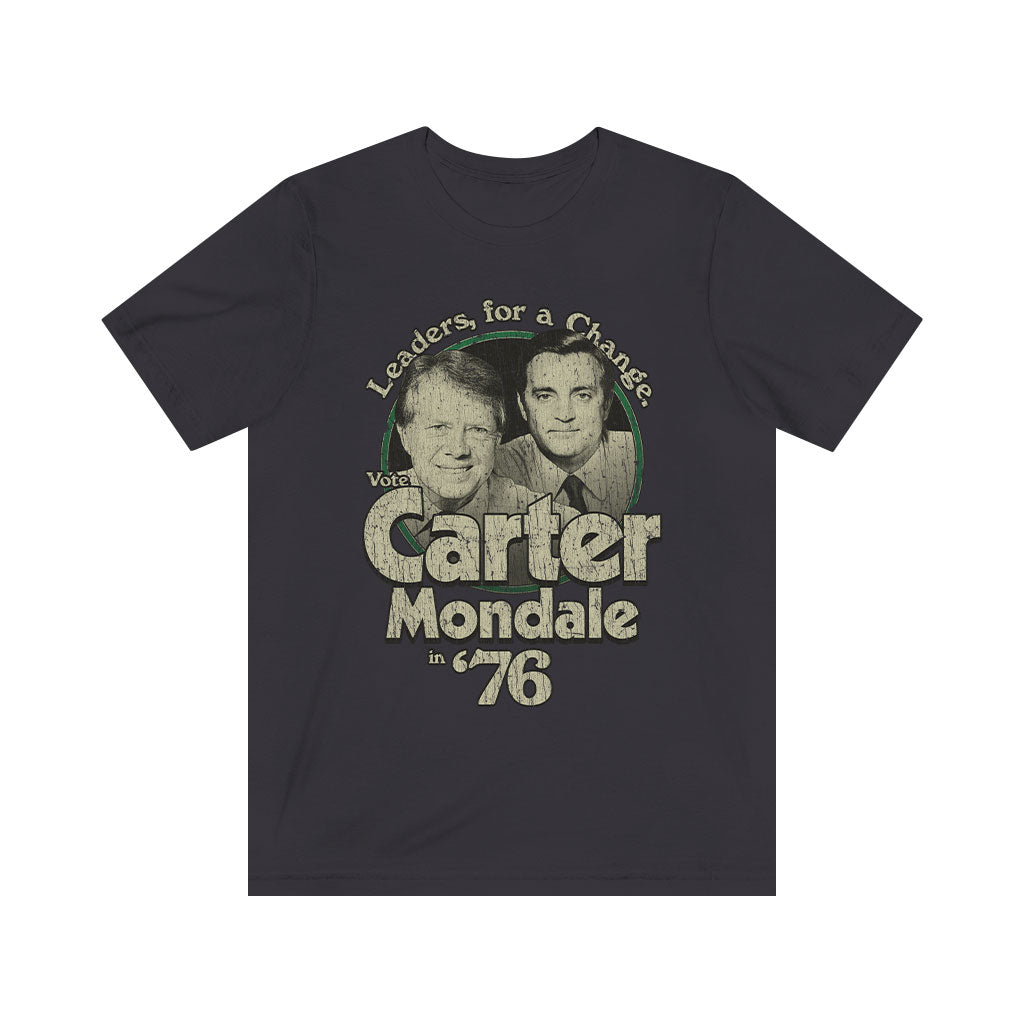
Jimmy Carter and the Great Leap of Faith was published in Rolling Stone, June 3, 1976, after Hunter Thompson attended the 1976 Democratic Convention, where he is pictured here… in the men’s room with a cigarette and a beer.


