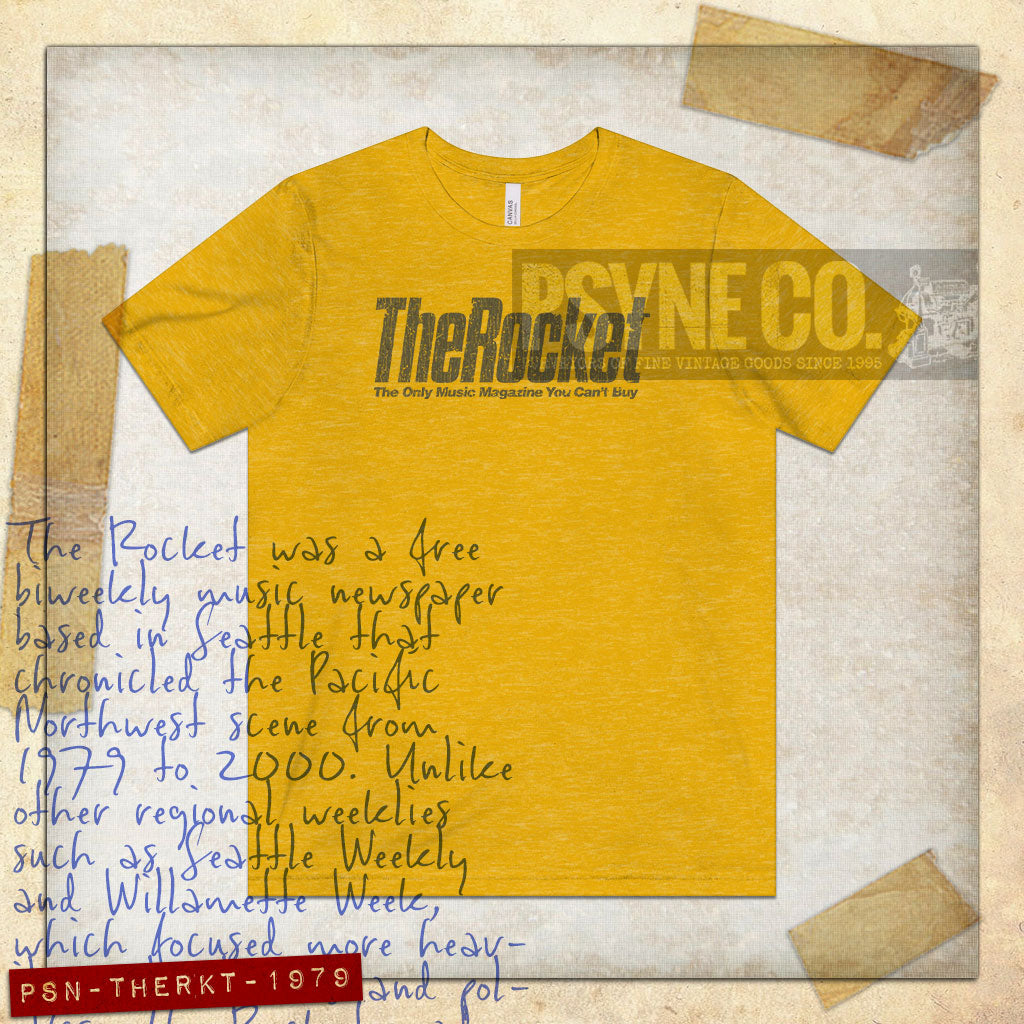
Long before Seattle became shorthand for flannel shirts, distortion pedals, and the early-1990s grunge explosion, the city already had a publication devoted to documenting the music bubbling beneath the surface. The Rocket first appeared on Seattle streets on October 31, 1979, initially as a special music edition of the alternative newspaper The Seattle Sun. Distributed free, it arrived at exactly the right moment: punk, new wave, independent rock, and a new generation of local bands were beginning to shake up a Northwest scene that had spent much of the 1970s dominated by conventional bar bands and touring acts. The new paper promised to cover nationally known performers while remaining committed to the musicians playing Seattle’s clubs, taverns, theaters, and makeshift venues.
 Edited at first by Robert Ferrigno and published by Robert McChesney, The Rocket quickly developed an identity distinct from Seattle’s general alternative weeklies. Music wasn’t merely an entertainment section tucked between politics and restaurant reviews—it was the entire reason for the paper’s existence. Its writers covered new records, interviewed musicians, reviewed shows, ran concert calendars, reported on clubs and radio stations, and provided inexpensive classified ads where musicians could hunt for bandmates. In one now-famous example, Kurt Cobain placed a “Drummer Wanted” ad in The Rocket in 1988, several years before Nirvana transformed Seattle from an obscure regional rock town into the center of the international music business.
By the early 1980s, The Rocket had become an essential part of Seattle’s musical ecosystem. Its offices sat in Belltown, first at the B. F. Shearer Building at 2318 Second Avenue from 1981 to 1986 and later at another downtown location. The paper existed alongside college station KCMU, independent record stores, small labels, rehearsal spaces, promoters, and clubs that collectively allowed unusual local music to survive before major labels were paying attention. Contributors frequently crossed over into other parts of that world as DJs, label employees, historians, promoters, and musicians themselves. The Rocket didn’t simply report on a music scene from the outside; in many ways, its staff and readers were part of the same community they were covering.
 Under longtime editor and publisher Charles R. Cross, who acquired the publication in the mid-1980s, The Rocket grew substantially. Its circulation eventually reached roughly 90,000 copies throughout the Northwest and British Columbia, giving it influence far beyond Seattle. The magazine became known not just for its writing but for adventurous illustration, photography, typography, and cover art. While the editorial staff generally had an affection for underground, independent, and alternative music, its pages weren’t confined to a single genre. Punk, metal, hip-hop, roots music, pop, experimental acts, established stars, and forgotten local bands could all find space there. That breadth helped make old issues something close to a running diary of Pacific Northwest popular culture.
Its timing was particularly fortunate. During the 1980s, The Rocket documented bands such as the Fastbacks, Green River, Soundgarden, Mudhoney, and countless others while they were still primarily local concerns. Seattle hip-hop received attention as well; the paper enthusiastically covered Sir Mix-A-Lot and the locally based Nastymix label at a time when Northwest rap received comparatively little recognition from the national press. By the time Nirvana’s Nevermind exploded in 1991 and reporters descended on Seattle in search of “the Seattle sound,” The Rocket had already been writing about the region’s underground for more than a decade.
The publication expanded south in 1991 with a Portland edition, giving Oregon’s music community a more substantial presence in its pages. The Seattle and Portland versions generally shared their major articles while carrying regional differences such as local concert calendars and, occasionally, different cover stories. In 1994, The Rocket increased its schedule to biweekly publication. By then, the once-obscure Northwest music scene it had championed had become internationally famous. Pearl Jam, Nirvana, Soundgarden, Alice in Chains, and other Seattle-area acts were selling millions of records, yet The Rocket continued giving space to bands that might never get much farther than a neighborhood club.
 Ironically, The Rocket survived Seattle’s transition from musical backwater to global rock capital only to stumble after the boom had begun to fade. Cross sold the publication to San Francisco-based BAM Media in 1995. According to contemporary accounts summarized by HistoryLink, problems elsewhere in the company’s publishing operation placed increasing financial pressure on The Rocket. In 2000, it was sold again, this time to David Roberts, publisher of the Illinois Entertainer. Hopes that new ownership might rejuvenate the magazine disappeared almost immediately. Roughly two months after the sale, the operation was abruptly shut down amid declining revenues. The Rocket’s final issue was dated October 18, 2000, ending a run of nearly twenty-one years.
Its disappearance left a genuine hole in Northwest music culture. What makes The Rocket important in retrospect isn’t simply that it happened to cover Nirvana and Soundgarden before they became famous. For more than two decades, it treated local music as something worth documenting in its own right, whether the band involved was destined for a platinum record or a half-empty Tuesday-night show in a Seattle tavern. Its old pages preserve thousands of reviews, advertisements, club listings, interviews, cartoons, photographs, and arguments about bands now famous, forgotten, or somewhere in between.
For anyone interested in the history of Seattle music, The Rocket offers something more valuable than the familiar story of grunge suddenly erupting in 1991. It shows the years of punk clubs, college radio, independent records, oddball bands, cheap rehearsal rooms, and passionate local journalism that made that eruption possible. By the time the rest of the world finally turned its attention toward Seattle, The Rocket had already been there for years, taking notes.