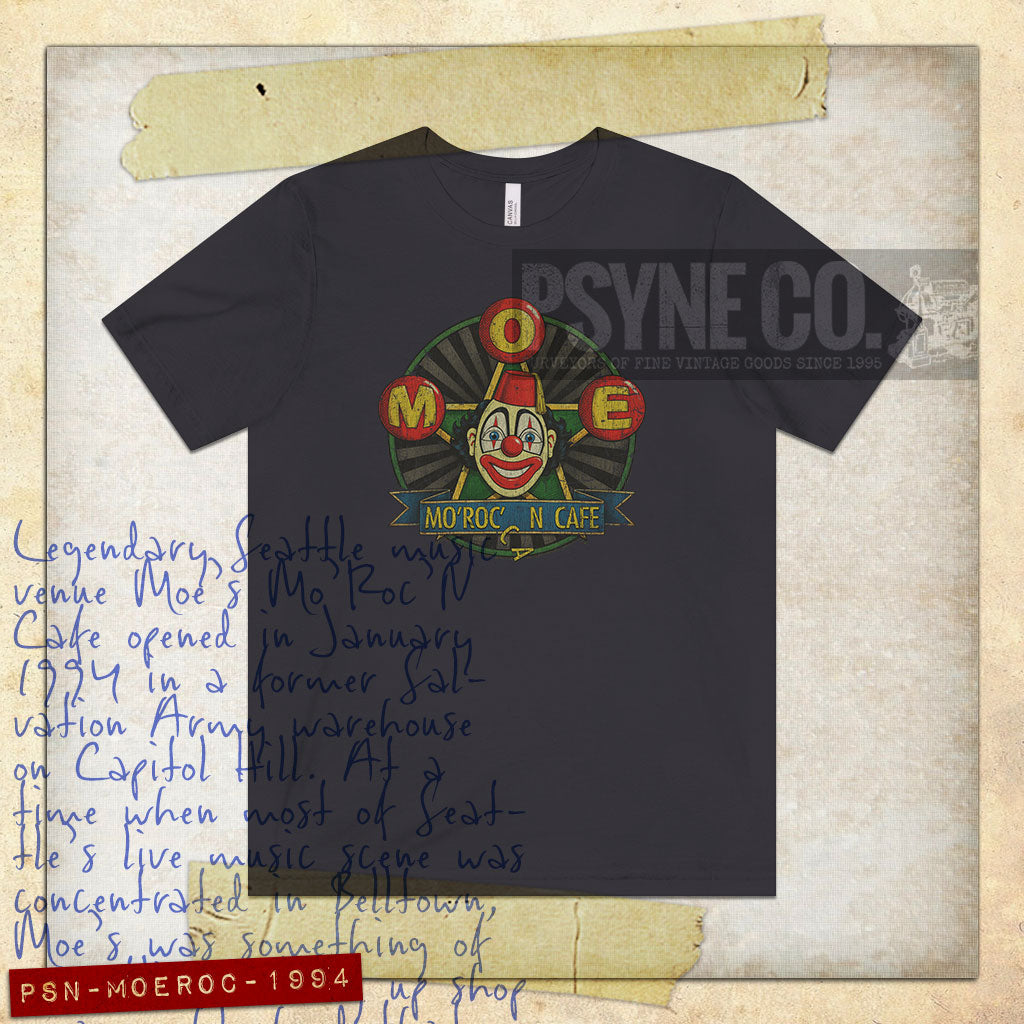
During the early 1990s, Seattle was the undisputed epicenter of alternative rock, with grunge having transformed the city’s underground music scene into an international phenomenon. While much of the action was concentrated in Belltown and Pioneer Square, a new venue was about to help establish Capitol Hill as one of Seattle’s most important live music destinations. That venue was Moe’s Mo’Roc’N Café, a legendary nightclub whose relatively brief existence would leave an enduring mark on the city’s musical history.

Moe’s opened in January 1994 at 925 East Pike Street, occupying a former Salvation Army warehouse at the corner of Pike Street and 10th Avenue. The club was established by Jerry Everard, Eric Shirley, and Graham Graham, all of whom had been involved with the popular Crocodile Café. Their goal was to create a purpose-built music venue that offered something better than the typical bar with a stage squeezed into the corner. With an exceptional sound system, unobstructed sightlines, spacious backstage accommodations, and even showers for touring musicians, Moe’s quickly developed a reputation as one of the most musician-friendly clubs in the Pacific Northwest.

The venue’s unusual name was partly a product of Washington’s restrictive liquor laws, which required establishments serving hard alcohol to operate as restaurants and generate a percentage of their revenue from food sales. Moe’s consequently offered a Middle Eastern-inspired menu, with its Moroccan theme lending itself to the playful Mo’Roc’N Café name. Although the restaurant component was necessary to keep the drinks flowing, the real attraction was always the music. The venue’s first live performance came in February 1994, courtesy of Seattle’s Tiny Hat Orchestra, and it wasn’t long before Moe’s was attracting an impressive roster of local and national talent.
Throughout its four-year run, Moe’s hosted an extraordinary collection of bands, including Radiohead, Oasis, Portishead, Bush, Garbage, The Flaming Lips, 7 Year Bitch, and The Presidents of the United States of America. Many of these acts performed at Moe’s before achieving widespread commercial success, giving audiences the opportunity to experience future superstars in a relatively intimate setting. The venue also became an important home for Seattle’s independent music community, providing a welcoming environment where emerging artists could build an audience and established musicians could perform without the trappings of larger concert halls.

One of Moe’s most memorable nights came on June 7, 1995, when Neil Young and members of Pearl Jam performed an invitation-only concert previewing their collaborative album Mirror Ball. The intimate show became the stuff of Seattle rock legend, demonstrating just how influential the club had become. Moe’s was equally important to the emerging national touring circuit, frequently serving as the starting point for American tours by international acts. Oasis, for example, kicked off a North American tour at the venue in September 1994, just as the British band’s popularity was beginning to explode.
Despite its success, Moe’s Mo’Roc’N Café closed in June 1998, bringing an abrupt end to one of Seattle’s most celebrated music venues. By then, the city’s musical landscape had changed considerably. The grunge explosion had subsided, alternative rock was evolving, and electronic music was becoming increasingly popular. The building subsequently housed several other entertainment ventures, including the electronic music-oriented ARO.space and Noiselab, but for many Seattle music fans, the space would always be remembered as Moe’s.

Fortunately, the story didn’t end there. In February 2004, the venue reopened as Neumos Crystal Ball Reading Room, with the name pronounced “New Moe’s” as a tribute to its predecessor. The revived club carried forward the original concept of providing a first-rate live music experience, eventually becoming one of Capitol Hill’s most recognizable nightlife institutions. Although the original Moe’s lasted just four years, its influence extended far beyond its relatively short lifespan. By helping shift Seattle’s musical center of gravity toward Capitol Hill, nurturing emerging talent, and hosting some of the most memorable performances of the 1990s, Moe’s Mo’Roc’N Café earned a permanent place in the history of Seattle rock ‘n’ roll.