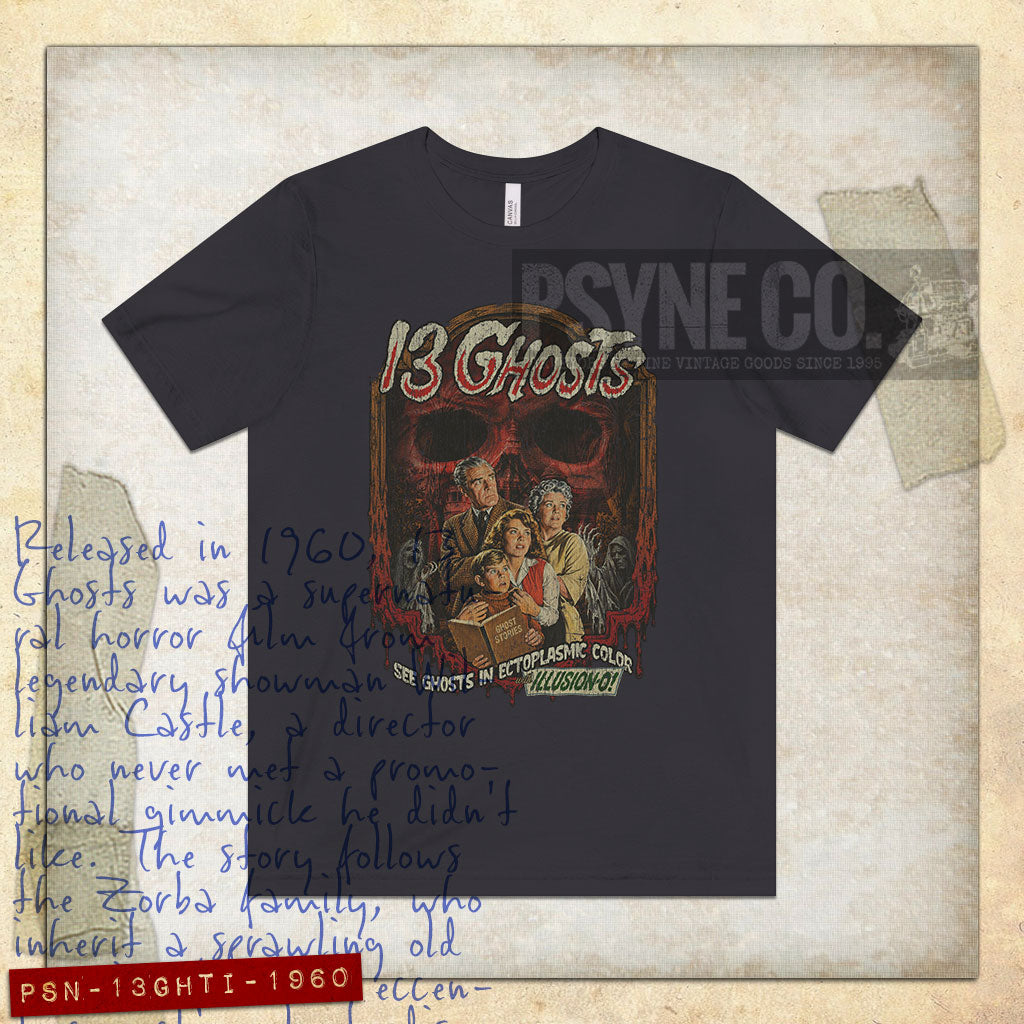
Back in the days when horror movies were as much about the theater experience as the scares on screen, nobody knew how to put on a show quite like William Castle. The legendary producer and director made a career out of turning relatively low-budget fright flicks into must-see events, using outrageous promotional gimmicks that practically dared audiences to buy a ticket. His 1960 supernatural thriller 13 Ghosts was no exception, delivering a creepy old mansion, a collection of restless spirits, and one of the most memorable movie gimmicks of the era: Illusion-O!, a special viewing process that supposedly allowed moviegoers to see ghosts—or make them disappear.
Released by Columbia Pictures in the summer of 1960, 13 Ghosts was directed and produced by Castle from a screenplay by his frequent collaborator Robb White. The film follows the financially struggling Zorba family, whose fortunes seemingly change overnight when patriarch Cyrus Zorba (Donald Woods) inherits a sprawling, fully furnished Victorian mansion from his recently deceased uncle, Dr. Plato Zorba. For Cyrus, his wife Hilda (Rosemary DeCamp), daughter Medea (Jo Morrow), and young son Buck (Charles Herbert), the unexpected windfall seems almost too good to be true. Naturally, it is.
 Uncle Plato, it turns out, wasn’t your average eccentric relative. He was a scientist obsessed with the supernatural who had spent years collecting ghosts, and his mansion came complete with a dozen rather unpleasant spectral residents. There’s also a mysterious housekeeper named Elaine Zacharides, played by Margaret Hamilton, best remembered as the Wicked Witch of the West in 1939’s The Wizard of Oz. With her ominous demeanor and suspiciously witch-like appearance, Hamilton was perfectly cast as the creepy caretaker who knows considerably more about the house than she’s willing to admit.
Things get increasingly strange as the family encounters unexplained noises, moving objects, hidden passages, and other unsettling phenomena. Fortunately, Uncle Plato left behind a special pair of ghost-viewing goggles that make the invisible inhabitants visible. Among the mansion’s supernatural attractions are a flaming skeleton, a floating head, a screaming woman, a murderous chef, and even a ghostly lion accompanied by its unfortunate, headless trainer. As the family digs deeper into Plato’s experiments, it becomes apparent that the mysterious 13th ghost may be the most dangerous of all.
 Illusion-O! See the Ghosts… or Don’t!
Of course, the real attraction wasn’t necessarily the ghosts themselves, but how audiences got to experience them. For 13 Ghosts, Castle introduced Illusion-O!, a wonderfully cheesy theatrical gimmick that turned moviegoers into active participants in the supernatural proceedings.
Upon entering the theater, audience members were given a cardboard Ghost Viewer, a simple handheld device containing two colored cellophane filters, one red and one blue. During specially prepared sequences, the screen would change to a bluish tint, signaling viewers to raise their devices and choose whether they wanted to see the ghosts.
Looking through the red filter intensified the ghostly apparitions, while looking through the blue filter caused them to fade from view. Castle presented the choice as a test of courage: believers and brave souls could look through the red filter, while skeptics and scaredy-cats could use the blue one to make the supernatural nasties disappear.
 The effect was achieved by superimposing red-tinted ghost images over blue-tinted backgrounds, allowing the colored filters to selectively reveal or suppress the apparitions. Although the viewers resembled the red-and-blue glasses associated with 3D movies, 13 Ghosts wasn’t actually presented in 3D. Both eyes looked through the same colored filter, and the effect was essentially an optical trick. The ghosts were even visible without the viewer, but where was the fun in that?
Castle personally introduced the process in a filmed prologue, explaining how to use the viewers and encouraging audiences to participate. At the end of the movie, he even suggested taking the devices home and trying them out in a darkened room, just in case there happened to be a few ghosts lurking around the house.
It was pure showmanship, and it was exactly the kind of thing that made going to the movies in 1960 such an experience.
 The King of the Movie Gimmicks

By the time 13 Ghosts hit theaters, Castle had already established himself as Hollywood’s undisputed king of the gimmick. For his 1958 thriller Macabre, he promoted a $1,000 life insurance policy against death by fright. The following year, House on Haunted Hill introduced Emergo, which involved a plastic skeleton floating over theater audiences during a climactic scene. Then came The Tingler (1959), featuring Percepto!, a process that equipped selected theater seats with vibrating devices designed to give unsuspecting moviegoers an unexpected jolt.
Compared to flying skeletons and electrified-seat theatrics, Illusion-O was a relatively simple affair, but its genius was in giving the audience a sense of control. Rather than merely sitting in the dark waiting to be frightened, viewers were invited to become part of the show. Even kids who might otherwise have been too scared to watch a horror movie could theoretically make the ghosts disappear with the flip of a cardboard viewer.
Castle understood something that many filmmakers overlooked: the anticipation of being scared could be every bit as entertaining as the scare itself. His films were never just movies; they were events, complete with elaborate advertising campaigns, outrageous promises, and enough carnival-style hucksterism to make P.T. Barnum proud.
 A Haunted House Full of Old-School Charm
Viewed today, 13 Ghosts is more of a spooky family adventure than a genuinely terrifying horror movie. Its apparitions are delightfully theatrical, its special effects are charmingly primitive, and its haunted-house atmosphere owes as much to carnival dark rides as it does to traditional Gothic horror.
But that’s a big part of its appeal. There’s something wonderfully nostalgic about a movie that relies on creaking doors, eerie shadows, floating objects, and a menagerie of costumed ghosts to deliver its thrills. The Victorian mansion provides an appropriately ominous setting, while the youthful enthusiasm of Charles Herbert’s Buck Zorba gives the film an almost kid-friendly quality.
Margaret Hamilton’s performance adds another layer of fun, particularly for audiences who remembered her terrifying turn as the Wicked Witch. Her character’s mysterious behavior keeps the family—and the audience—guessing about whether she’s simply an eccentric old housekeeper or something considerably more sinister.
The film also offers a glimpse into an era when horror didn’t necessarily need graphic violence or elaborate makeup effects to entertain. Sometimes a dark hallway, an unexplained noise, and the possibility of something waiting around the corner were more than enough.
 The Legacy of 13 Ghosts
Like many of Castle’s productions, 13 Ghosts received a mixed response from contemporary critics, some of whom regarded the Illusion-O process as little more than a distraction. But audiences looking for a fun night at the movies weren’t necessarily interested in critical approval. They wanted ghosts, surprises, and a little something extra for the price of admission.
Over the decades, 13 Ghosts became a nostalgic favorite among classic horror enthusiasts and William Castle devotees. Its unique theatrical presentation also made it a sought-after curiosity for collectors, particularly those interested in original promotional materials and surviving Illusion-O viewers.
Unfortunately, many television broadcasts and early home-video releases eliminated the original colored sequences and Castle’s introductory material, leaving viewers with a conventional black-and-white horror movie that lacked much of its original theatrical novelty. A 2001 DVD release eventually restored the Illusion-O presentation and even included a reproduction Ghost Viewer, allowing a new generation to experience Castle’s gimmick much as audiences had in 1960.
The film also inspired a considerably more elaborate 2001 remake, Thir13en Ghosts, which replaced Castle’s relatively innocent haunted-house shenanigans with grotesque supernatural creatures, elaborate mechanical sets, and modern special effects. While the remake developed a following of its own, it was a very different beast from the charmingly campy original.
More than six decades after its release, 13 Ghosts remains a wonderfully entertaining reminder of a time when going to the movies meant more than simply watching a film. William Castle wanted audiences to scream, laugh, participate, and leave the theater with something to talk about. With 13 Ghosts, he even gave them a souvenir to take home.
And really, how many horror movies can claim to have handed every audience member their very own ghost detector? Those were the days.