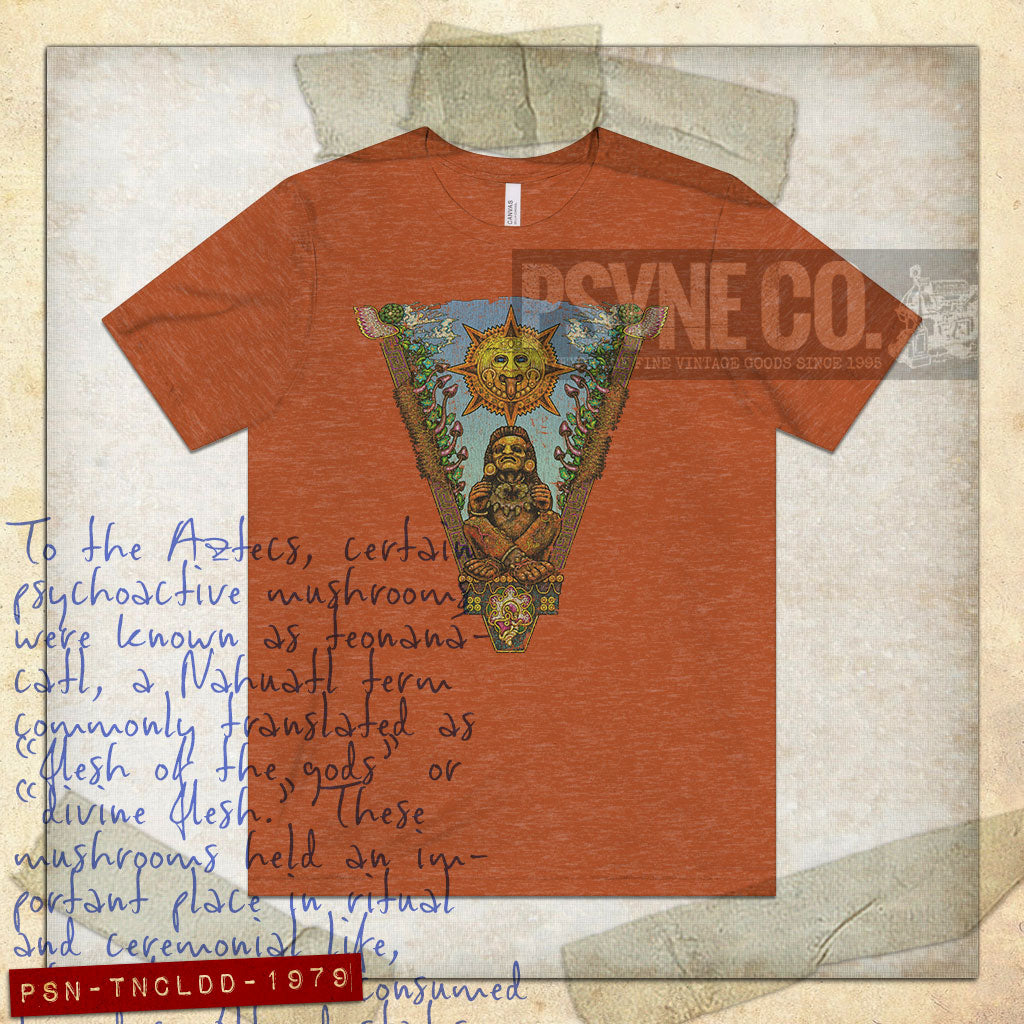
For the Aztecs, altered states of consciousness could serve as a means of approaching the supernatural world. Long before the Spanish conquest, peoples of central Mexico used a variety of psychoactive plants and fungi in religious ceremonies, divination, healing, and other ritual contexts. These substances were not simply recreational intoxicants in the modern sense. Their effects were understood within a spiritual framework in which visions and unusual sensations could carry religious significance or provide access to otherwise hidden knowledge.
 Among the best known was teonanácatl, a Nahuatl name generally translated as “divine mushroom,” “sacred mushroom,” or “flesh of the gods.” The term appears in early colonial accounts describing mushrooms with powerful intoxicating or visionary effects, generally understood today to have included psilocybin-containing species. Spanish Franciscan Bernardino de Sahagún recorded descriptions of their consumption among the Nahua, noting that the mushrooms could produce visions, laughter, weeping, fear, and other intense experiences. Other colonial writers described their ceremonial use at feasts and important gatherings.
Mushrooms were only one part of a much larger Aztec pharmacological and religious tradition. Ololiuhqui, the seeds of certain morning glory vines, was another important visionary substance. The seeds contain psychoactive ergoline alkaloids and were associated with divination and healing. Colonial records describe ritual specialists using ololiuhqui in attempts to diagnose illness, locate missing objects, or obtain answers to questions that could not be resolved through ordinary means.
Another particularly potent plant was toloache, generally associated with Datura species. Datura contains tropane alkaloids capable of causing delirium, hallucinations, confusion, and potentially fatal poisoning. Indigenous peoples of Mexico employed it in various medicinal and ceremonial contexts, but its effects differ considerably from those of psychedelic mushrooms. Rather than producing what would now typically be described as a classic psychedelic experience, Datura can cause a dangerous delirious state in which imagined events may become indistinguishable from reality.
 The peyote cactus, known in Nahuatl as peyotl, was also known in Mesoamerica by the time of the Spanish conquest. Its principal psychoactive compound, mescaline, produces profound changes in perception and consciousness. Peyote was particularly associated with Indigenous peoples farther north, but Aztec and early colonial sources demonstrate awareness of it in central Mexico as well, where it acquired medicinal and supernatural associations.
The surviving descriptions of these substances require some caution. Much of what historians know about Aztec drug use was recorded after the conquest by Spanish priests, physicians, and colonial officials. Their writings preserve invaluable Indigenous testimony, but European observers frequently interpreted unfamiliar ceremonies through a Christian worldview that characterized Indigenous gods and visionary experiences as demonic. Colonial authorities consequently attempted to eradicate many traditional practices, particularly those involving divination and communication with pre-Christian deities.
Despite this suppression, traditions involving sacred mushrooms and other psychoactive plants did not simply disappear. Some survived for centuries within Indigenous communities, particularly in southern Mexico, sometimes blending older beliefs with elements of Christianity. Modern scholarship has consequently helped place teonanácatl and related substances back within their original cultural setting—not merely as “hallucinogenic drugs,” but as components of sophisticated systems of religion, medicine, ritual, and knowledge.
The Aztec use of teonanácatl, ololiuhqui, peyote, and other consciousness-altering substances offers a glimpse into a worldview in which the boundary between the everyday and supernatural worlds was permeable. Visions could be meaningful experiences, plants could possess sacred powers, and entering an altered state under ritual circumstances could provide another way of understanding gods, illness, fate, and the mysteries of existence.