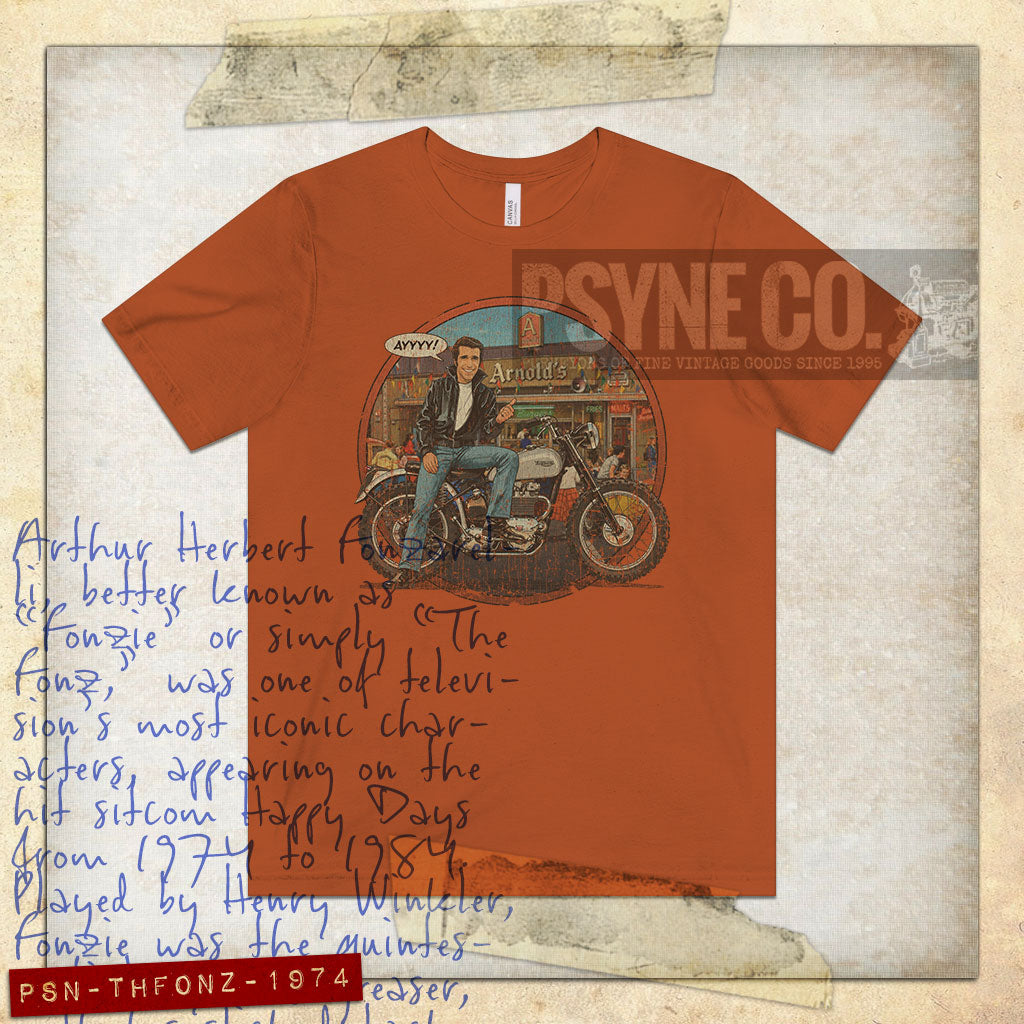
When Happy Days premiered on ABC in January 1974, Arthur “Fonzie” Fonzarelli, played by Henry Winkler, quickly became one of television’s most recognizable characters. With his slicked-back hair, leather jacket, white T-shirt, and seemingly limitless supply of cool, the Fonz embodied the rebellious spirit of 1950s motorcycle culture. Naturally, a motorcycle was an essential part of his image, but the bike most people associate with Fonzie wasn’t actually the one he started out riding. Over the show’s eleven-season run, which ended in 1984, several different motorcycles appeared, with changes reflecting both the evolution of the character and the practical realities of television production.

The Original Harley-Davidson Knucklehead (1974)
During the first season of Happy Days, Fonzie rode a customized 1947 Harley-Davidson Knucklehead bobber. The motorcycle featured a stripped-down appearance, a Sportster-style fuel tank, and custom modifications typical of the postwar American motorcycle scene. It was a substantial machine that perfectly suited Fonzie’s original characterization as a somewhat intimidating neighborhood tough guy.
The motorcycle was supplied by Hollywood vehicle specialist George Dockstader, and Chris Haynes served as its handler during filming. Unfortunately, there was one significant problem: Henry Winkler didn’t know how to ride a motorcycle. Haynes attempted to teach him, but Winkler was uncomfortable handling the big Harley. For scenes requiring Fonzie to ride into the frame, Haynes would start the motorcycle and get it moving in the right direction.
As Happy Days transitioned away from its original location-heavy production style and became more of a traditional studio sitcom, the Knucklehead proved impractical. The large motorcycle was difficult to maneuver around the sets, and the production team decided that something smaller and easier to handle would be preferable.
 Enter the Triumph Trophy TR5 (1975)
Beginning with the second season, the Harley-Davidson was replaced by a much lighter British motorcycle, the Triumph Trophy TR5. This became the definitive Fonzie motorcycle and the one most viewers remember today.
The production enlisted legendary motorcycle racer and Hollywood stuntman Bud Ekins to provide the replacement. Ekins was already famous for performing the spectacular motorcycle jump in the 1963 film The Great Escape, doubling for his friend Steve McQueen.
Ekins supplied customized Triumph motorcycles based on late-1940s and early-1950s Trophy TR5 models. The best-documented example was a 1949 Triumph Trophy 500, a 500cc parallel-twin machine originally developed for off-road competition.
To give the motorcycles an appropriately rebellious appearance, Ekins made several modifications, including installing raised buckhorn handlebars, fitting custom seats, removing the front fenders, and repainting the fuel tanks silver. The result was a stripped-down custom with just enough attitude to suit the Fonz without looking out of place in the show’s 1950s setting.
Three Triumphs were ultimately used during the series, allowing the production to alternate between motorcycles as needed. Although the bikes shared a similar appearance, they were not necessarily identical in every detail, and differences can be spotted in various episodes.
 A Motorcycle Becomes Part of the Story (1975–1980)
As Fonzie grew from a supporting character into the show’s breakout star, his motorcycle became increasingly important to the storylines.
In the September 16, 1975, episode appropriately titled The Motorcycle, Fonzie discovers that his beloved bike has been destroyed. The culprit turns out to be Ralph Malph, who accidentally ran over it with his car. Ralph eventually finds Fonzie a replacement motorcycle, which he must pay for by working at the garage.
Just one week later, in Fearless Fonzarelli, Fonzie attempts an Evel Knievel-inspired stunt in which he jumps his motorcycle over fourteen garbage cans outside Arnold’s Drive-In. Although he clears the cans, the landing goes badly, and he crashes into Arnold’s chicken stand, injuring his leg.
These episodes helped establish that the motorcycle was much more than transportation for Fonzie. It represented his freedom, independence, and carefully cultivated reputation as the coolest guy in Milwaukee.
 More Motorcycles and a New Ride (1981–1984)
As Happy Days progressed into the 1980s, different Triumph motorcycles continued appearing on screen. While the familiar silver TR5 remained the model most closely identified with Fonzie, variations in equipment and appearance reflected the multiple machines used during production.
The motorcycle even received another significant storyline in the eighth season. In The Sixth Sense, which aired January 13, 1981, Chachi points out that Fonzie’s aging motorcycle has seen better days. Fonzie initially refuses to replace it, but after crashing the bike, he reluctantly agrees that it’s time for something new.
Joanie, Chachi, and Jenny subsequently arrange to purchase Fonzie a replacement motorcycle as a birthday surprise, using money from his savings. The episode provided an opportunity to introduce another bike while emphasizing how much Fonzie’s friends cared about him.
By this point, Fonzie’s character had also changed considerably. The once-threatening greaser had evolved into a respected mechanic, teacher, and mentor, although his motorcycle remained a familiar symbol of his personality.
The Secret Behind Fonzie’s Motorcycle Skills
One of the great ironies of Happy Days is that Henry Winkler never actually became an accomplished motorcycle rider. Despite playing one of television’s most famous bikers, Winkler openly admitted that he was frightened of motorcycles.
Consequently, many scenes featuring Fonzie on a motorcycle relied on camera tricks and assistance from the production crew. Sometimes the motorcycles were pushed into position, while other scenes used stationary bikes or specially arranged camera angles to create the illusion that Fonzie was riding.
For dangerous sequences, including his famous garbage-can jump, stunt performers handled the actual riding.
The motorcycles themselves weren’t necessarily running during filming, either. In a 2000 interview with Cycle World, Bud Ekins recalled that one of the surviving Triumphs had been started only once during its time associated with the production. As long as it looked convincing on camera, it didn’t particularly matter whether it ran.
In other words, Fonzie’s legendary motorcycle skills were largely Hollywood magic, but that didn’t make the character any less convincing.
 Whatever Happened to Fonzie’s Motorcycles?
After Happy Days ended in 1984, the motorcycles followed very different paths.
The original 1947 Harley-Davidson Knucklehead continued working in Hollywood, appearing in other productions before eventually passing into private ownership. It was later acquired by motorcycle collector George Roeder Jr., who restored it to its Happy Days appearance. In February 2023, the restored motorcycle returned to Milwaukee for an appearance at the Mama Tried Motorcycle Show.
The Triumphs have a more complicated history. Of the three motorcycles associated with Bud Ekins, two disappeared from the documented trail after production ended. The surviving 1949 Triumph TR5 eventually made its way into the collection of California motorcycle dealer Marshall Ehlers.
After being rediscovered and documented, the motorcycle began appearing at major auctions. It sold for $179,200 in 2018 and achieved an even more remarkable $231,562 at a Bonhams auction in December 2021. The purchaser was Richard Rawlings of Gas Monkey Garage, who had fond childhood memories of watching Happy Days with his father.
 The Coolest Motorcycle on Television
Although Fonzie began his television career aboard a Harley-Davidson, it was the humble British Triumph that ultimately became inseparable from his identity. The smaller motorcycle was easier for the production crew to manage, looked great on camera, and perfectly captured the spirit of a young 1950s mechanic who preferred a customized secondhand machine to something expensive and flashy.
Over eleven seasons, the motorcycles changed, were wrecked, replaced, and occasionally modified, but their significance remained constant. They represented everything the Fonz stood for: independence, confidence, and just enough rebellion to keep things interesting.
And while Henry Winkler might never have mastered the art of riding a motorcycle, he certainly convinced an entire generation that nobody looked cooler sitting on one.
Aaaaay!